
Zirconia restorations have become widely used in modern dentistry due to their excellent mechanical strength, biocompatibility, and natural esthetics. Compared with traditional porcelain-fused-to-metal crowns, zirconia ceramics are closer to natural teeth in color and translucency, providing patients with durable and lifelike restorations that meet the growing demand for dental esthetics.
As patients pay more attention to esthetic outcomes, shade selection has become one of the most important aspects in zirconia restorations. Understanding color theory, recognizing shades accurately, and mastering shade matching techniques are essential steps for dental professionals to achieve natural-looking results. This article introduces the use of professional dental shade guides — including their classification, naming, and practical tips for use.
A shade guide consists of a series of color tabs, each representing specific color parameters that simulate the range of natural tooth shades. By comparing the shade tabs to a patient’s teeth, technicians and clinicians can determine the most suitable color for the zirconia restoration.
The VITA Classical Shade Guide divides colors into four major hue groups — A, B, C, and D — each with several brightness and chroma levels:
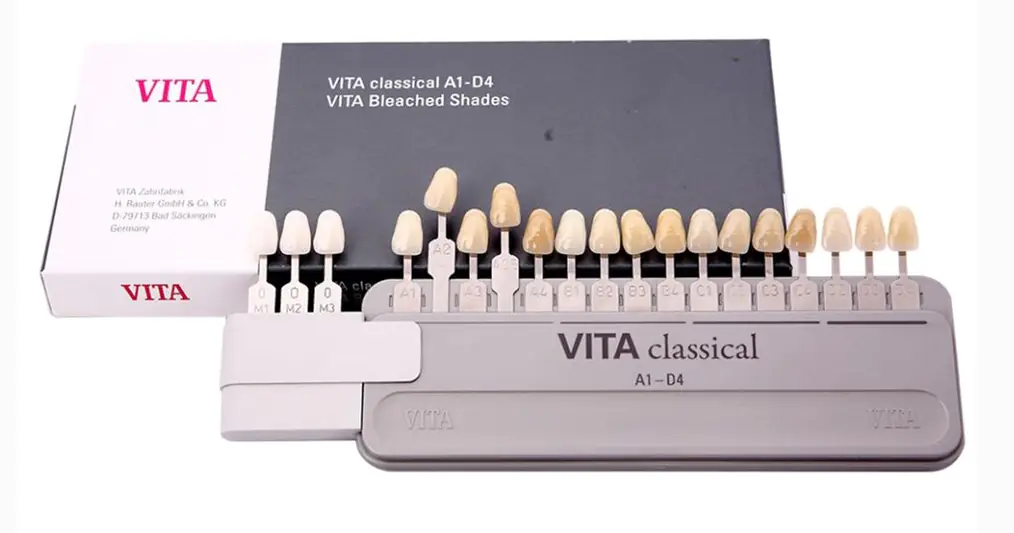
| Hue Group | Color Tone | Shades |
|---|---|---|
| A Group | Reddish-Brown | A1, A2, A3, A3.5, A4 |
| B Group | Reddish-Yellow | B1, B2, B3, B4 |
| C Group | Grayish | C1, C2, C3, C4 |
| D Group | Reddish-Gray | D2, D3, D4 |
While the VITA Classical system is still widely used, it offers limited coverage and lower precision. To improve color accuracy and standardization, VITA introduced the 3D-Master Shade Guide, which provides a more comprehensive and scientific approach based on the three-dimensional color parameters of lightness, chroma, and hue.
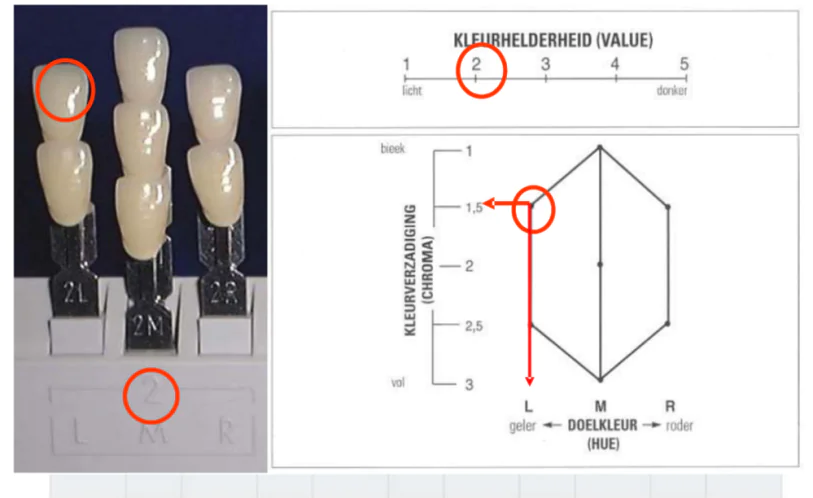
The VITA 3D-Master guide divides shades first by value (brightness), then by chroma (intensity), and finally by hue (color tone: L for yellowish, M for neutral, and R for reddish). This system ensures a more consistent and predictable shade selection process, helping technicians reproduce natural tooth colors with greater confidence.
In color science, the CIE (International Commission on Illumination) defines color in a three-dimensional space — lightness (L*), a* (red-green axis), and b* (yellow-blue axis).
This model helps describe tooth color precisely:
Lightness (L*) determines how bright or dark the tooth appears. Proper lightness ensures that the restoration blends harmoniously with adjacent teeth.
a* and b* values fine-tune the red, green, yellow, or blue tones, helping achieve a natural shade match.
In simple terms:
Lightness corresponds to the black–white scale (brightness).
Chroma represents color saturation — how vivid or muted a color appears.
Hue defines the actual color family, such as yellow, red, or gray.
Step 1 – Determine the Value (Lightness)
Place the 3D-Master shade guide next to the tooth under neutral daylight. Start by comparing the lightest and darkest tabs to identify the closest brightness group (1–5). Record the selected group.
Step 2 – Determine the Chroma (Saturation)
Within the selected brightness group, open the middle “M” tab set and compare the color intensity. Choose the tab that best matches the saturation level — 1 for low, 2–3 for medium, and higher numbers for more intense shades. Record the result.
Step 3 – Determine the Hue (Color Tone)
Finally, identify the hue based on the tooth’s underlying tone:
L – more yellowish
M – neutral tone
R – more reddish
By combining the three parameters (lightness, chroma, and hue), the correct shade can be selected accurately — for example, 2L1.5 indicates brightness level 2, yellowish tone (L), and chroma 1.5.
Accurate shade matching ensures that zirconia restorations blend seamlessly with natural dentition. It minimizes the visual differences between the prosthetic and natural teeth, improving both esthetics and patient satisfaction. In addition, standardized shade systems like VITA Classical and 3D-Master enable better communication between dentists and dental technicians.
By using scientific shade-matching methods, clinicians can create restorations that meet both functional and cosmetic expectations — achieving a natural, harmonious smile.
As a professional manufacturer of zirconia materials for dental applications, HONCHON has been committed to continuous color research and technological improvement. We focus on achieving precise and consistent shade results in our zirconia blocks, ensuring color stability and accuracy throughout production.
If you have any questions about zirconia shade matching or need technical support, our team is always ready to assist you.
HONCHON – Your Trusted Partner in Zirconia Materials.


