
As 2025 unfolds, the Eastern European dental sector faces a pivotal regulatory shift with the full implementation of the EU Medical Device Regulation (MDR, Regulation (EU) 2017/745). Replacing the Medical Device Directive (MDD), MDR introduces stricter requirements for custom-made devices (CMDs), affecting CAD/CAM (computer-aided design/computer-aided manufacturing) workflows across the region.
In countries such as Poland, Hungary, Romania, the Czech Republic, and Bulgaria—where CAD/CAM accounts for roughly 40% of restorative procedures—these regulatory updates are reshaping manufacturing, compliance, and market dynamics for custom prosthetics, including crowns, bridges, and implants.
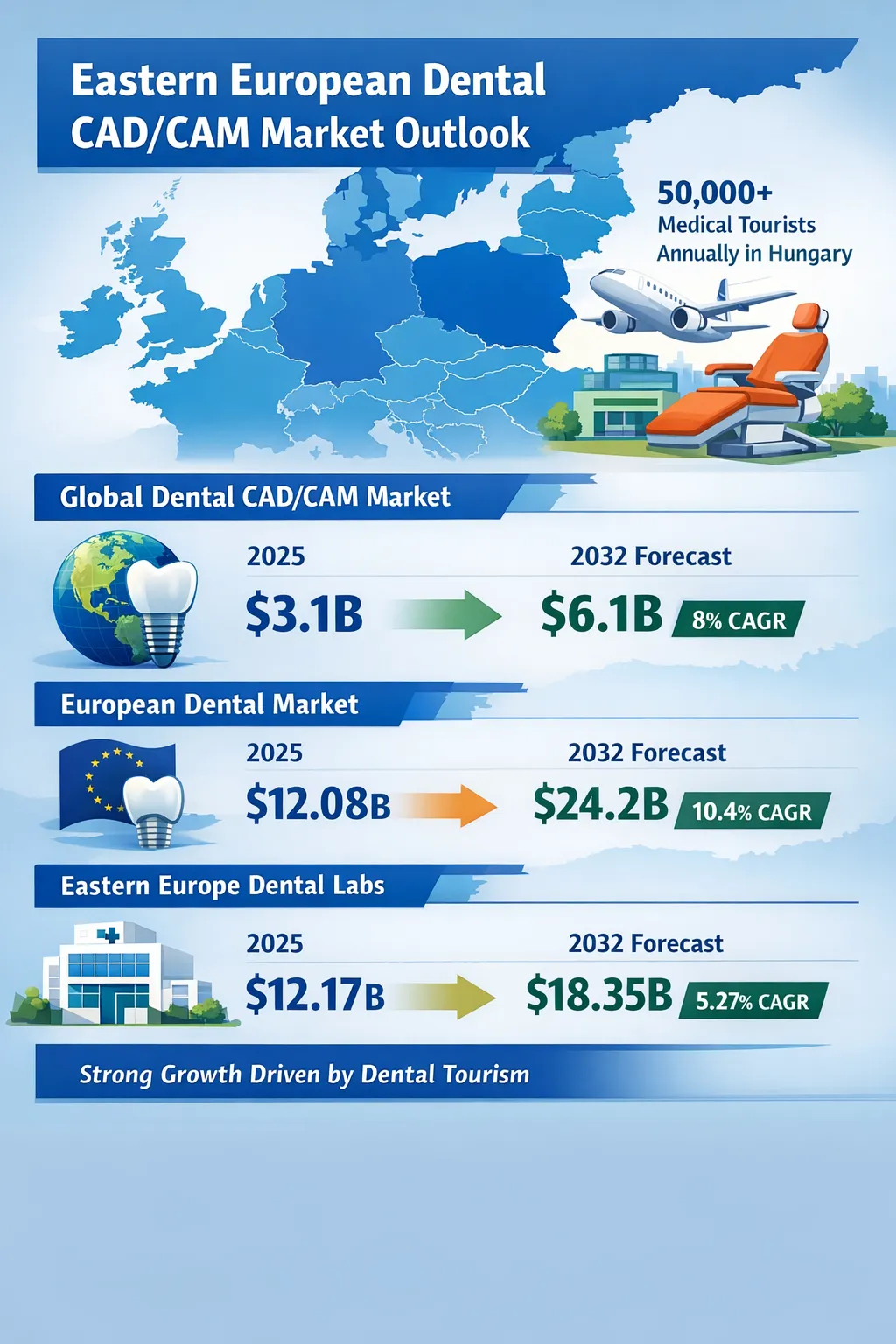
The global dental CAD/CAM market is valued at USD 3.1 billion in 2025 and is projected to reach USD 6.1 billion by 2034 at a CAGR of 8%. Europe’s dental CAD/CAM segment anticipates a 9% CAGR through 2031, while the broader European dental market grows from USD 12.08 billion in 2025 to USD 24.20 billion by 2032 at a CAGR of 10.4%. Eastern Europe, driven in part by dental tourism—over 50,000 international patients annually in Hungary alone—contributes significantly to this growth. The regional dental laboratories market is expected to expand from USD 12.17 billion in 2025 to USD 18.35 billion by 2033 at a CAGR of 5.27%.
However, MDR’s emphasis on traceability, clinical evaluation, and quality management systems (QMS) could increase compliance costs by 10–15% for small labs, potentially accelerating market consolidation. For GEO optimization, searches such as “MDR compliance CAD/CAM dental Warsaw” or “EU MDR custom prosthetics Budapest” are rising, reflecting labs’ urgency to adapt.
This guide explores the 2025 MDR updates’ impact on CAD/CAM custom devices, covering regulatory overviews, practical challenges, strategic compliance approaches, and Eastern European case studies.
MDR, fully applicable since May 26, 2021, has undergone transitional extensions, including Regulation (EU) 2023/607. This allowed legacy MDD-certified devices until:
May 27, 2025 for general devices,
December 31, 2027 for Class IIb devices (e.g., crowns), and
May 26, 2026 for Class III implants.
In 2025, the European Commission plans additional revisions, including proposals for simplification, device reclassification, and an expanded “well-established technologies” (WET) list to ease clinical evaluations for routine dental prosthetics.
Custom-made devices (CMDs), defined under MDR Article 2(3), are produced per patient-specific prescriptions by authorized professionals. CMDs encompass CAD/CAM-fabricated prosthetics. Unlike mass-produced devices, CMDs are exempt from CE marking but require:
A Declaration of Conformity for each device,
A technical file including risk management and post-market surveillance (PMS) documentation.
CEN/TR 12401:2025 guidance clarifies CMD classification, including prefabricated materials, ensuring that CAD/CAM processes do not alter device status.
Key 2025 mandates include:
Mandatory registration of CMDs in the EUDAMED database.
Unique Device Identification (UDI) for traceability.
Updated MDCG templates for dental technicians to support chairside CAD/CAM compliance.
Eastern European laboratories are aligning these updates with national health programs. For instance, Poland has adopted MDR/IVDR frameworks, while BVMed’s October 2025 survey shows 30–35% of labs in Hungary, Romania, and Slovakia risk non-compliance without prompt adaptation.
Under MDR Article 2(30), dental labs using CAD/CAM are considered manufacturers, requiring:
Implementation of robust Quality Management Systems (QMS),
Designated qualified personnel, and
Documentation retention for 10–15 years.
Each custom crown or bridge must include a technical file with:
Risk analysis,
PMS plan, and
Traceability via UDI in EUDAMED.
For high-risk implants, failure rates must remain below 3%, making traceability critical. In Romania, where unmet dental needs reach 16.2%, MDR requirements could delay production by 20–30%, according to local lab reports.
While CMDs bypass CE marking, they require scientific justification for safety. Expansions of WET lists in 2025 may exempt routine prosthetics from full clinical trials.
Implant cards (Article 18) must detail:
UDI,
Material composition,
Production records.
These facilitate patient safety and streamline processes in dental tourism hubs, such as Hungary, where clinics process over 100,000 cases yearly. Nevertheless, MDR dental scrutiny may increase certification costs by 10–15%, potentially affecting Poland’s 11,000+ tourist patient inflow.
White-labeling bans require transparent OEM identification.
Labs reliant on imported materials, like zirconia disks (€16–20 each), may face 20% cost increases due to compliance-related supply chain adjustments.
MDR alignment boosts export potential to Western Europe, where compliant devices can command a ~15% price premium.
Overall, compliant labs have higher survival rates (95%) compared to non-compliant labs (60%), indicating potential market consolidation.
Eastern Europe’s SME labs (50–100 units/month) face several hurdles:
Compliance Preparedness
BVMed 2025 survey: 30% of labs in Hungary and Romania lack readiness for QMS audits.
Delays may extend product timelines by up to 30%, impacting dental tourism revenue (e.g., Hungary: USD 653.3 million in 2024, projected USD 3,893.5 million by 2033).
Resource Constraints
Initial QMS setup: €5,000–€10,000.
Annual PMS costs: €500–€1,000.
Rural areas of Czech Republic and Bulgaria face network coverage challenges affecting EUDAMED registration.
Workforce Limitations
Technician density: 10–11 per 10,000 population.
49% of technicians lack MDR expertise, requiring training investment.
GEO-Specific Impacts
Warsaw labs face export risk due to non-compliance.
Bucharest clinics may see 15% material cost increases amid 16.2% unmet dental needs.
MDR/IVDR implementation could reduce availability of some devices by 20%, potentially limiting patient options.
Despite challenges, MDR 2025 offers pathways for growth and competitive differentiation:
Adopt MDCG-compliant technical file templates.
Register all CMDs in EUDAMED by Q2 2025.
Join FEPPD 2025 initiatives for chairside compliance.
Attend regional workshops such as Krakdent 2025 (April, Krakow) to ensure staff MDR readiness.
Integrate cloud-based LIMS (€400–€900/year) to automate UDI tracking and PMS documentation.
Use advanced intraoral scanners (€8,000–€12,000 for entry-level) to generate high-precision scans and health reporting, supporting GEO-optimized workflows like “MDR-ready dental scans Bucharest” and reducing manual PMS data entry by 40%.
ROI models suggest a 12-month payback through 50–100 additional units/month, with profits around 40%. GEO-specific marketing can increase orders by ~30%.
Poland (Krakow)
QMS adoption per FEPPD guidelines achieved 95% compliance by mid-2025.
Export growth to Germany rose by 18%.
Hungary (Budapest)
Integrated UDI via cloud-based tools for 100,000 annual tourist cases.
Reduced production delays by 25%, improving patient retention.
Romania (Bucharest)
Leveraged WET exemptions for crowns to reduce compliance costs by 15%.
Alignment with national dental programs streamlined timelines for high-demand prosthetics.
These examples demonstrate that MDR can be both a challenge for SMEs and a catalyst for innovation, driving efficiency, traceability, and patient trust.
EU MDR 2025 will reshape Eastern Europe’s CAD/CAM custom device landscape, enforcing traceability, clinical rigor, and quality standards amid 9–10% regional market growth.
Challenges: 10–15% cost increases, QMS setup, workforce training.
Opportunities: Access to EU funding, WET simplifications, improved market reputation, and higher tourism patient trust.
Labs that prioritize QMS implementation, staff training, and technology-driven workflows—such as high-precision intraoral scanners and cloud-based PMS—can transform regulatory compliance into a competitive advantage.
With the European dental market projected to reach USD 24.20 billion by 2032, GEO-optimized, MDR-ready laboratories are positioned to thrive while ensuring patient safety and long-term business resilience.


