
In modern dental laboratories, dental milling machines play a crucial role in producing precise and long-lasting restorations. The quality of zirconia blocks directly impacts the accuracy, durability, and aesthetic outcome of crowns and bridges. According to industry reports, the global dental zirconia block market exceeded 6 million units in 2023 and is projected to grow at an annual rate of 8% through 2028, driven by the adoption of CAD/CAM workflows in clinics and labs worldwide. High-quality zirconia blocks, when combined with advanced dental milling machines, ensure restorations with outstanding longevity and minimal rework.
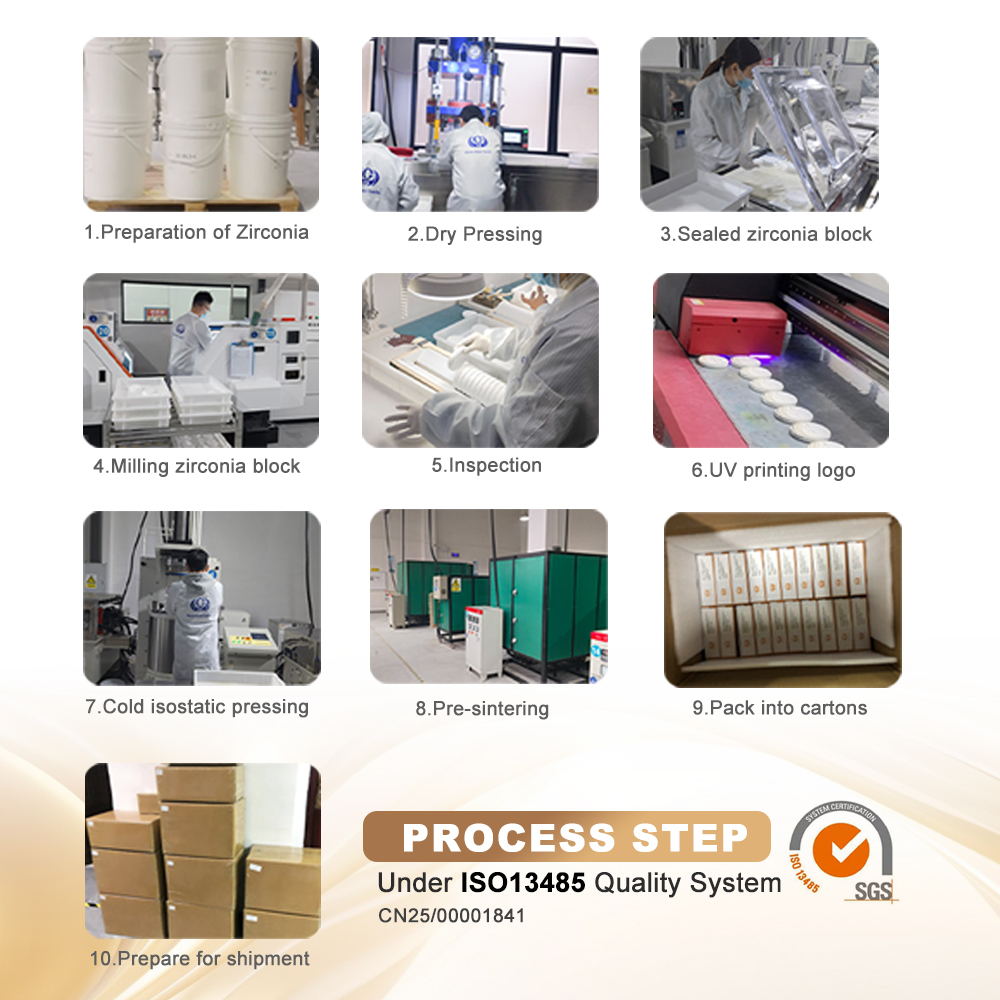
The foundation of reliable restorations is material stability. High-performance zirconia blocks maintain uniform density throughout, thanks to the cold isostatic pressing (CIP) process. Blocks with a density of 6.0 g/cm³ demonstrate minimal variation after sintering, preventing deformation, chipping, or edge fractures. A German dental lab reported that post-sintering deformation dropped from 3% to below 0.5% after adopting CIP-prepared zirconia blocks, improving lab reliability and precision for CAD/CAM milling.
Durability is critical for restorations subjected to daily chewing forces. High-strength zirconia blocks offer:
Flexural strength up to 1100 MPa
Standard blocks around 650 MPa
These values far exceed traditional ceramics, reducing the probability of fracture to less than 1%. All blocks are ISO 6872 compliant, guaranteeing international quality standards. Clinical studies show that crowns fabricated with 1100 MPa zirconia blocks have a 5-year survival rate of 98.5%, compared to 94% for traditional metal-ceramic restorations.
Aesthetic outcomes are just as important as strength. Modern zirconia blocks achieve:
Ultra-translucent (UT) blocks: up to 49% light transmittance
Standard blocks: approximately 43%
Such translucency allows technicians to match natural tooth color and gradient. Color stability remains within ΔE<2 even after 10 years, ensuring restorations maintain a natural appearance over time.
Sintering is a critical stage in zirconia processing. Reliable blocks resist warping, chipping, or edge cracking after sintering. CIP-pressed blocks ensure uniform shrinkage and minimal deformation, allowing dental milling machines to achieve dimensional accuracy within 20 microns. A Japanese dental lab reported a 30% reduction in post-sintering remakes after adopting CIP-prepared zirconia, increasing workflow efficiency and reducing material waste.
Choosing high-quality zirconia blocks with stable density, high flexural strength, ISO 6872 compliance, and excellent sintering behavior is essential for producing durable, aesthetic restorations. By combining these blocks with advanced dental milling machines, dental labs can maximize precision, reduce remakes, and increase patient satisfaction.
At HONCHON, we specialize in manufacturing CIP-prepared, high-strength zirconia blocks compatible with a wide range of dental milling machines. Our products provide consistent density, superior translucency, and precise sintering behavior, ensuring that every crown, bridge, or restoration meets the highest clinical standards. Partner with HONCHON to enhance your lab’s efficiency, quality, and profitability in modern digital dentistry.


